

KEY HIGHLIGHTS
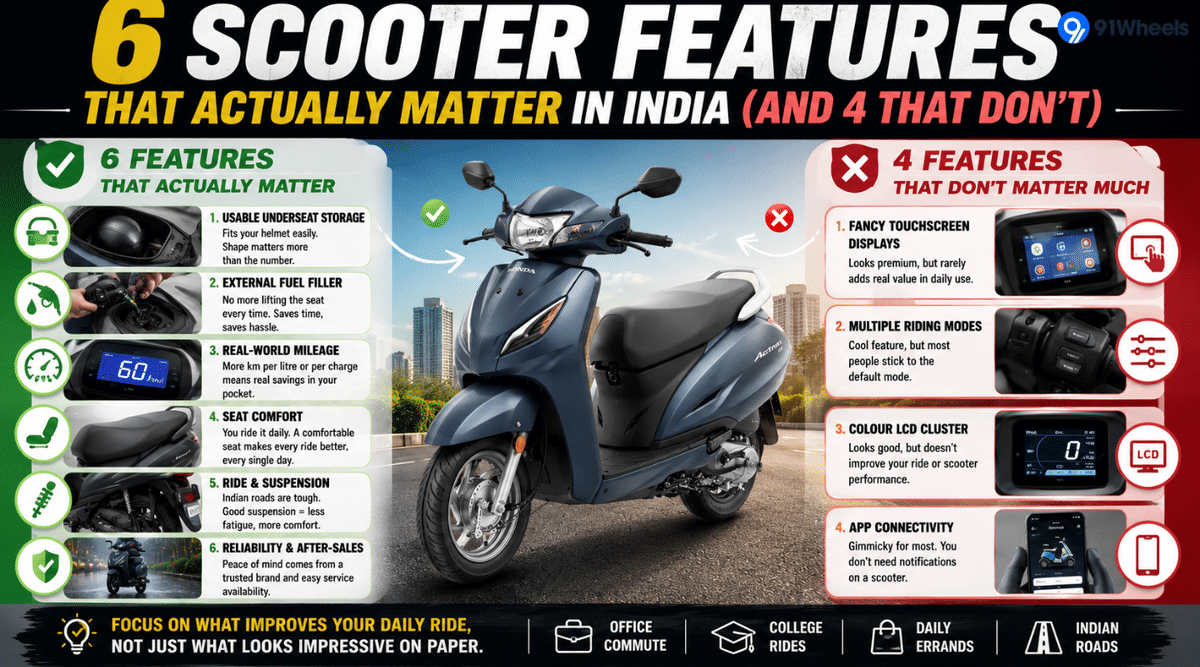
- Not all scooter features are worth the premium you pay for them
- Practical basics like storage and seat comfort beat flashy tech every time
- Real-world mileage and ARAI figures are rarely the same number
- Some features sound great on paper but go unused within a month
- The right scooter is the one built for how India actually rides
Buying a scooter in India sounds straightforward - until you're at the dealership, drowning in variants and confused by features you don't fully understand. The truth is, most of what gets highlighted in showrooms rarely matters once you're out on the road. What actually makes a difference is far more basic - and far more practical. Here's an honest look at what's worth your money, and what really isn't. More below, in the meantime do join our 91Wheels WhatsApp Channel to never miss out on the latest automotive updates.
Also Read: Campus Rizz on Two Wheels: Best Bikes Under 2 Lakh
Features That Matter
External Fuel Filler Cap
In a country where petrol pumps have queues, where nozzle operators are in no mood to help you lift the seat, and where the person behind you is already revving impatiently - an external fuel filler cap is not a convenience. It is dignity.
Scooters that require you to open the seat before refuelling force an awkward, sometimes dangerous dance at the pump. You're blocking the lane, balancing a helmet, and hoping the seat latch cooperates. The Honda Activa has had an external cap for years. That's not an accident. Honda spent decades studying Indian pump behaviour and built accordingly.
Scooters on sale with external fuel cap - TVS Jupiter 110, Suzuki Avenis 125, and Suzuki Access 125.
Underseat Storage - Actual Usable
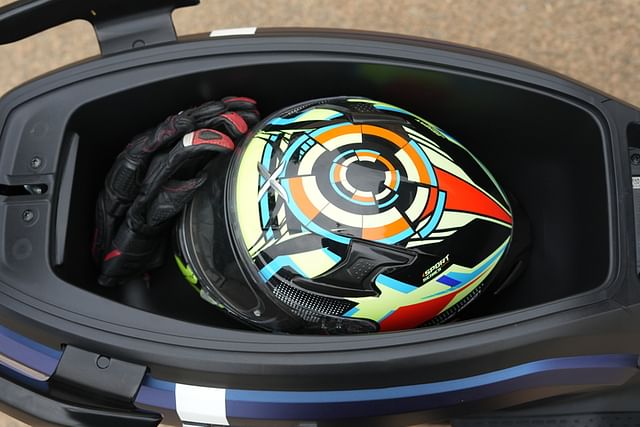
Not all underseat storage is created equal, and this is where marketing loves to blur lines. "21 litres" sounds generous until you discover it's shaped like a crescent, designed around a battery pack, and can't fit a full-face helmet without a fight.
For Indian usage, the minimum useful benchmark is: one standard ISI-certified full-face helmet, plus a thin rain jacket, plus a small bag. If any scooter can't clear that bar, it fails the grocery run, the school drop, the weekend errand.
The Honda Activa 6G offers 18 litres of usable storage space, while the Suzuki Access 125 gets a notably deeper underseat compartment. Some EVs, despite claiming large storage capacities on paper, have awkwardly partitioned spaces that reduce practicality. Always test the storage with your actual helmet before buying, and also check out scooters that offer the best storage space in the segment.
Engine Refinement & Vibration
Nobody talks about NVH - Noise, Vibration, Harshness - in scooter conversations. Everyone notices it within a week of buying. An engine that buzzes through the floorboard at 50 km/h doesn't just irritate: it fatigues. Over a 30-minute commute, it compounds.
Honda's eSP-equipped engines are buttery. The TVS Jupiter's engine is well-isolated. Contrast that with some budget competition that feels like holding an electric toothbrush between your thighs at 45 km/h. Real-world vibration matters most at city speeds - 30 to 60 km/h - which is precisely where Indian riders spend 90% of their time.
Refinement also directly correlates to long-term reliability. A smooth engine is one that's been engineered carefully, right through. Rough engines usually mean compromised tolerances everywhere else too.
Seat Comfort & Height
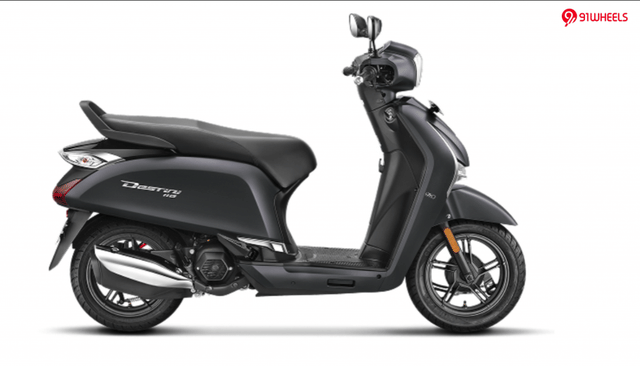
Scooter seats in India carry multiples - rider, pillion, occasionally a child in between. A flat, wide seat with adequate foam density isn't a luxury spec, it's a structural requirement for the way this vehicle is actually used.
Low seat height matters enormously for shorter riders and women, who still represent a rapidly growing buyer segment. A 770mm seat height sounds fine on paper but cuts off access for anyone under 5'3". The TVS Jupiter Grande and Honda Activa have historically calibrated seat heights better than most competitors.
Thin seat cushioning that goes hard within 8 months - a common cost-cut - means pillion misery on anything beyond a 10-minute ride. Ask your dealer when the demonstration model's seat was last replaced. That will tell you everything.
Suspension Calibration For Indian
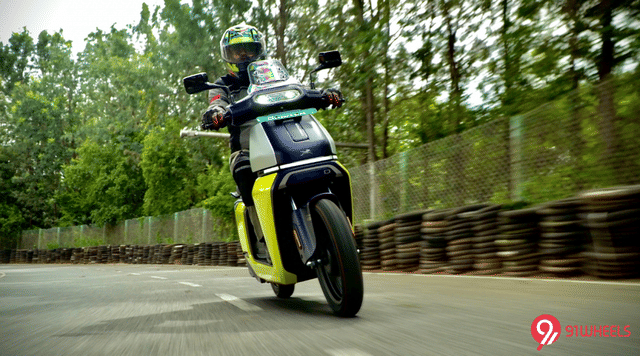
India does not have roads. India has a selection of organised potholes connected by brief stretches of tarmac. Any scooter that hasn't been specifically tuned for this - and many import-spec or budget models haven't - will bottom out, clang, and abuse your spine within a kilometre of the showroom.
Telescopic front forks are now table stakes; monoshock rear units have become mainstream. What matters is spring stiffness calibrated for two-up riding - most Indian scooters carry a pillion more often than not. The Suzuki Burgman Street's suspension setup is notably forgiving. The Honda Dio's has improved significantly in recent iterations.
Always test with the rear preload set for two passengers. That's how most Indians actually ride.
Fuel Efficiency - Real-World
ARAI-certified mileage is a laboratory condition that your commute will never replicate. The only number that matters is what riders in your city, on your kind of roads, with your kind of traffic, actually report - and that data is freely available on owner communities found on social media.
A difference of 10 km/l sounds abstract. Run the math: 40 km daily commute, 300 working days, petrol at Rs 98/litre. A scooter returning 50 km/l saves you nearly Rs 2,500 annually over one returning 40 km/l. Over five years, that's a service cost recovered.
This also means engine size matters less than engine efficiency. A well-mapped 110cc engine can trounce a poorly calibrated 125cc in this department.
Features That Don't
LED DRLs
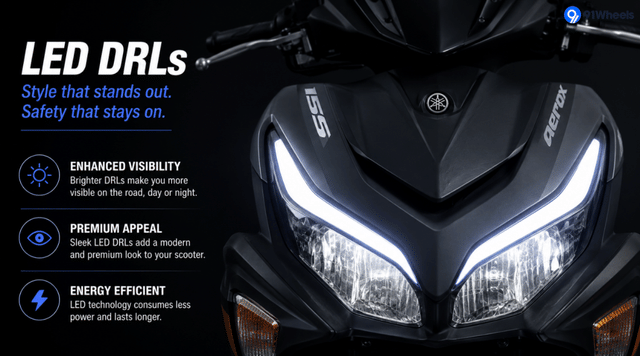
Manufacturers have discovered that LED strips make a scooter look expensive in a showroom at 6 PM. Indian buyers have discovered the same thing and started asking for them. Neither party has paused to ask: does this help you actually ride better?
LED DRLs improve daytime visibility marginally and are genuinely useful on highways. In city bumper-to-bumper traffic, nobody notices your DRL. The fancy ambient strips around the panel? They've been broken on 40% of scooters we spotted in the wild because they're routed poorly through the headset and corrode in monsoon humidity.
LED headlights are genuinely worth having. But the theatrical strip lighting around the speedometer and panels? Pure theatre. Budget accordingly.
Bluetooth Connectivity & App Integration
Every premium scooter now offers smartphone connectivity - turn-by-turn navigation on the instrument cluster, call notifications, music controls. The idea is lovely. The execution, and more crucially the usage pattern, is not.
Indian riders who actually use navigation use Google Maps audio through an earphone - already illegal to use while riding, widely done anyway. The scooter's tiny instrument cluster navigation is too small to read at speed, too distracting to glance at in traffic, and too fiddly to pair reliably in a hot parking lot.
App connectivity features also tend to develop bugs post-OTA updates that manufacturers never fully fix because it costs money and affects a small user base. OBD health monitoring is genuinely useful; social media integration is not worth Rs 6,000 in variant cost.
Large Alloy Wheels (12-inch & above)
Bigger wheels look sportier. This is unarguable. They also cost more to replace, have fewer tyre options in Tier 2 cities, require re-tuning of the suspension to maintain ride comfort, and add unsprung weight that actually worsens pothole absorption on badly surfaced roads.
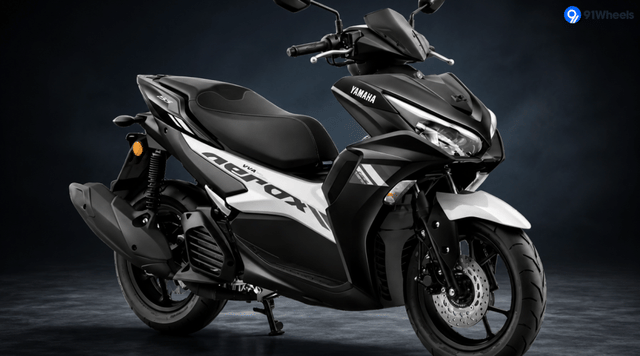
The 10-inch wheel format that most economy scooters use is a deliberate choice informed by decades of Indian road feedback. It gives a lower ride height, better manoeuvrability in tight lanes, and widely available, cheaper tyre options at every roadside puncture shop - including that one near Karol Bagh that's open at 11 PM.
For those who value aesthetics, fine - go 12-inch. But don't pay a premium believing it improves the riding experience on city roads. It doesn't, reliably.
Top-Speed Bragging Rights
The average Indian scooter owner in an urban area spends 85% of riding time below 45 km/h. The remaining 15% might see 60 km/h on an arterial road or highway stretch. A scooter that tops out at 80 km/h versus one that hits 95 km/h makes exactly zero difference to daily life.
Performance metrics that matter in Indian city riding: 0-40 km/h acceleration (for weaving and lane hopping), low-speed tractability (for crawling in jams), and mid-range punch at 30-50 km/h. Top speed is irrelevant, except as a dinner table argument.
Verdict
FAQs
Is the Honda Activa still the safest buy in 2026?
For most Indian buyers, yes - primarily because of service network density, parts availability, and proven reliability over decades. It's not the most exciting scooter, but it scores well on every feature that actually matters in daily use. Its main weakness is suspension, which remains average compared to the Suzuki Access or TVS Jupiter. If you're in a city with terrible roads, test the Jupiter.
Should I buy the top-spec variant for the connected features?
Only if you specifically need the Bluetooth for call management hands-free. The mid-spec variant of most scooters - which includes the essentials like LED headlights, decent storage, and better seat foam - offers far better value. The Rs 5,000 - 8,000 premium for top-spec typically buys you connectivity and cosmetics, not better core function.
How much does real-world mileage differ from ARAI ratings?
Typically 15-25% lower. A scooter rated at 60 km/l by ARAI will deliver 45-50 km/l in mixed city conditions with a pillion occasionally. In heavy stop-go traffic, mileage can drop further. Always use real-owner reported figures from owner communities. Moreover, urban mileage in Mumbai differs from highway mileage in Rajasthan.
Are disc brakes worth paying for on a scooter?
Marginally, for city riding at typical scooter speeds. The improvement in braking performance is real but incremental at urban speeds. CBS - now mandatory on all new scooters - does more for safety than drum vs disc in stop-and-go conditions. Disc brakes become more meaningful if you frequently ride highways or carry heavy loads.
What's the single most overlooked feature buyers should inspect?
The shape of the underseat storage matters more than the quoted capacity. Before buying, check whether your helmet fits properly without struggling, because that practicality makes a big difference in daily use.
Do you like this article?
Comments
No comments yet. Be the first to comment!