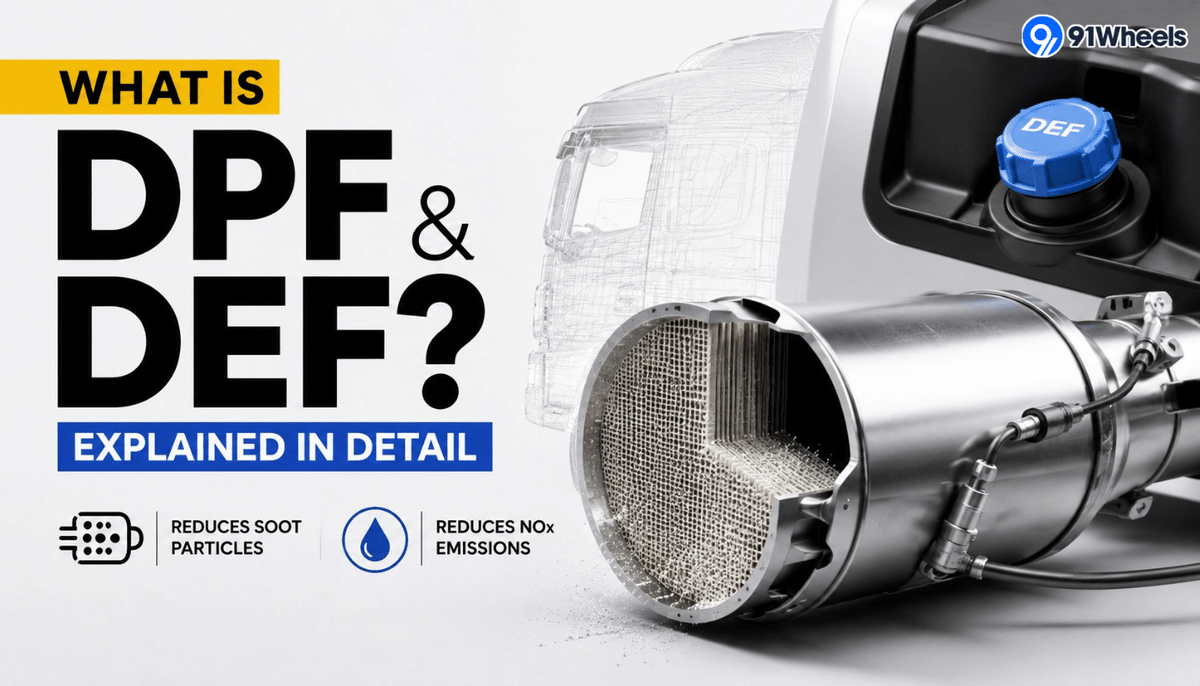
If you've ever glanced at a diesel vehicle's spec sheet or popped the bonnet of a modern diesel car, chances are you've run into two acronyms that sound almost interchangeable but do completely different jobs: DPF and DEF. Both exist because of the same root problem - diesel engines, for all their torque and fuel efficiency, produce exhaust that regulators around the world have grown increasingly strict about. But DPF and DEF tackle two entirely different pollutants, using two entirely different methods. Confusing the two is easy, and that confusion is exactly what this piece aims to clear up.
Read more: Are CNG Cars Safe? Here's All That You Need to Know
The Problem They're Both Solving
Before getting into what these systems are, it helps to understand why they exist at all. A diesel engine burns fuel under high compression, and that combustion process throws off two categories of nasty exhaust byproducts.
The first is soot - tiny, solid carbon particles that form when diesel fuel doesn't burn completely. Breathe in enough of this over the years and you're looking at serious respiratory health risks. This is the particulate matter problem.
The second is a family of gases called nitrogen oxides, usually written as NOx. These form when the nitrogen and oxygen in the air get forced together under the extreme heat and pressure inside a diesel combustion chamber. NOx gases are a major contributor to smog and acid rain, and they're linked to lung damage over prolonged exposure.
Here's the tricky part: engineers found that reducing one of these pollutants tends to increase the other. Tune an engine to burn cooler and you cut NOx but generate more soot. Tune it to burn hotter and cleaner to cut soot, and NOx goes up. You can't fix both problems with the same lever. That's precisely why the industry ended up with two separate systems - one purely mechanical, one chemical - bolted onto modern diesel vehicles.
DPF: The Soot Catcher
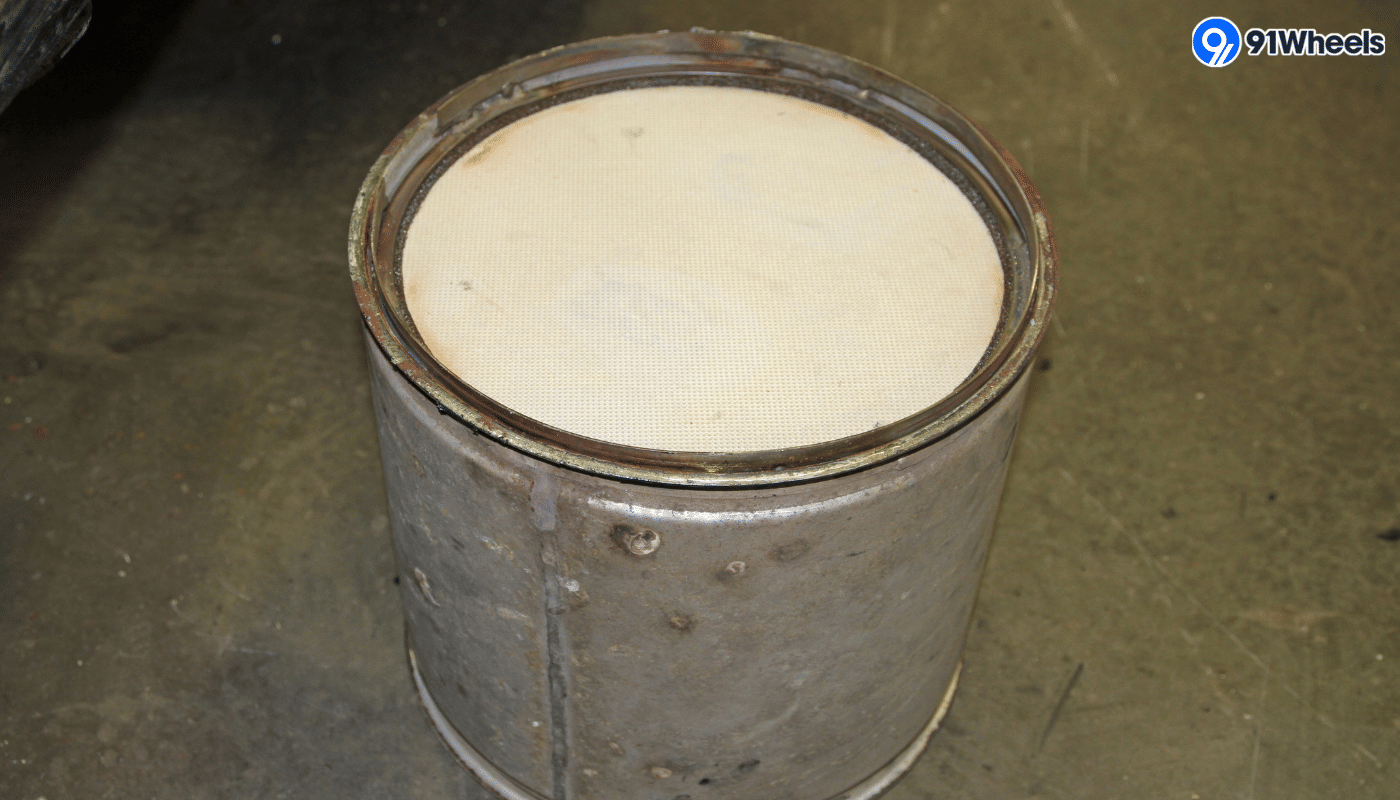
DPF stands for Diesel Particulate Filter. Think of it as a very sophisticated sieve sitting in the exhaust path, usually somewhere after the turbocharger and before the vehicle's exhaust outlet. Its entire job is to physically trap soot particles before they can escape into the atmosphere.
How It Actually Works
Inside a DPF is a honeycomb-like ceramic structure, typically made from cordierite or silicon carbide. Unlike a regular exhaust catalyst where gas flows straight through open channels, the DPF's channels are alternately blocked at each end - one sealed at the front, the next sealed at the back, and so on. This forces exhaust gas to squeeze through the porous ceramic walls to get from an inlet channel to an outlet channel. Gas molecules are small enough to pass through these microscopic pore walls, but soot particles are not. They get physically stopped and accumulate on the channel walls.
Over time, as you'd expect, this trapped soot builds up. If nothing were done about it, the filter would eventually clog completely, choking exhaust flow and strangling the engine. So the DPF has to periodically clean itself out through a process called regeneration - essentially burning off the accumulated soot at high temperature, converting it into a small amount of ash and carbon dioxide.
Passive vs Active Regeneration
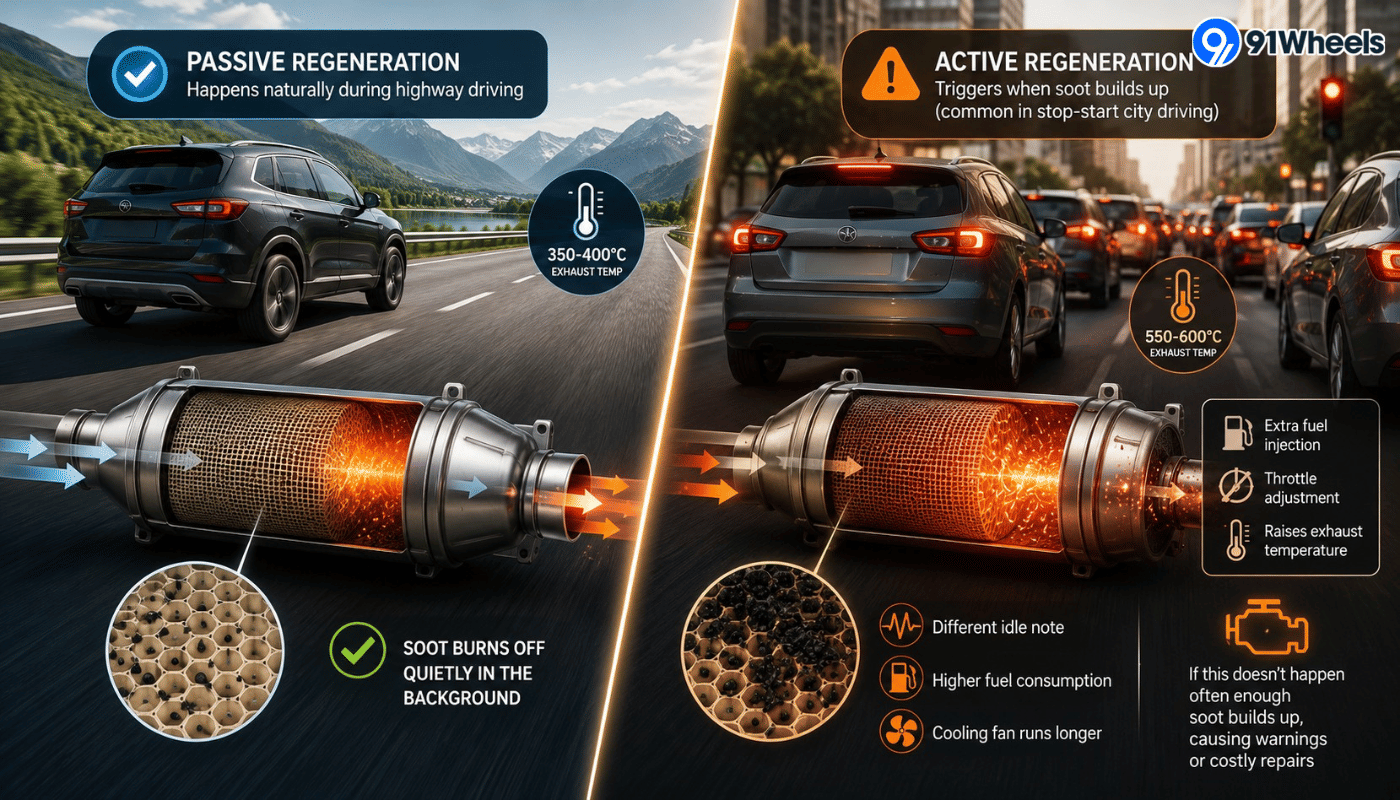
There are two ways this cleaning happens, and understanding both explains a lot of real-world driving behaviour around DPFs.
Passive regeneration happens quietly in the background during normal driving, particularly on highway runs where exhaust temperatures naturally climb high enough (typically above 350-400°C) to burn off soot without any special intervention from the car's computer. This is the ideal scenario - it just happens, and the driver never notices.
Active regeneration is what kicks in when passive regeneration hasn't had the chance to happen enough - say, in a car that's mostly driven in stop-start city traffic where exhaust temperatures rarely climb high enough on their own. In this case, the engine control unit deliberately intervenes: it might inject extra fuel late in the combustion cycle, adjust throttle behaviour, or use other tricks to artificially raise exhaust temperature to the 550-600°C range needed to burn off trapped soot. You might notice a slightly different idle note, a change in fuel consumption, or a longer-than-usual cooling fan run after you park - these are often signs an active regeneration cycle is happening or has just finished.
This is also why owners of diesel vehicles who do almost all their driving in short city hops sometimes run into DPF problems - the filter never gets hot enough often enough to clean itself, soot keeps piling up, and eventually the vehicle throws a warning light or, in worse cases, needs a costly filter replacement or forced regeneration at a service centre.
DEF: The Chemical Neutraliser

DEF stands for Diesel Exhaust Fluid, and this is where things shift from a purely mechanical filter to actual chemistry happening inside the exhaust system. DEF is a solution - roughly two-thirds purified water and one-third urea - that's stored in its own separate tank on the vehicle, entirely apart from the diesel fuel tank, and topped up through its own filler cap.
The Chemistry Behind It
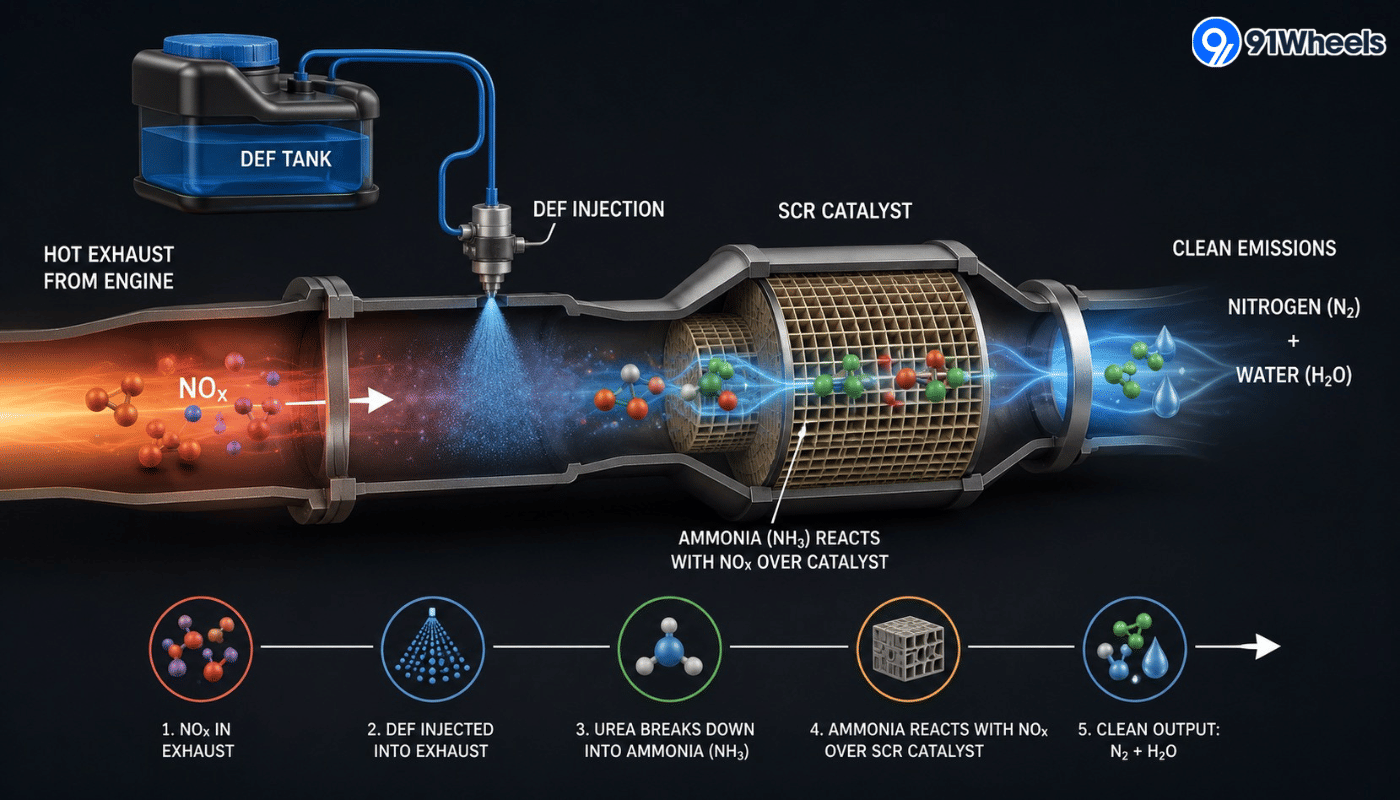
DEF is used in a process called Selective Catalytic Reduction, or SCR. Here's the sequence: as hot exhaust gas travels down the pipe, the vehicle's system injects a fine mist of DEF directly into that exhaust stream, right before it passes through a specialised SCR catalyst. The heat of the exhaust causes the urea in the DEF to break down into ammonia. That ammonia then reacts with the nitrogen oxides in the exhaust gas as they both pass over the catalyst surface, converting the harmful NOx into nitrogen gas and water vapour - both of which are already naturally abundant, harmless components of the air we breathe.
In effect, the DEF system is chemically dismantling a pollutant and turning it into things that don't hurt anyone. It's an elegant solution, but it depends entirely on that tank staying topped up.
Why the Tank Matters So Much
Because SCR only works when DEF is actually being injected, manufacturers build in strict safeguards around the DEF tank level. Most vehicles will start warning the driver well before the tank runs dry - often at a quarter tank remaining, then more insistently as it drops further. If a vehicle is allowed to run completely out of DEF, most modern diesel vehicles are programmed to limit engine performance, cap top speed, or in some cases refuse to restart entirely once switched off, specifically to prevent the vehicle from being driven with an inactive emissions control system. This isn't the vehicle malfunctioning - it's a deliberate, regulation-driven design choice to make sure diesel vehicles can't quietly bypass NOx controls by simply neglecting the DEF tank.
Unlike the DPF, which cleans itself through regeneration and rarely needs owner intervention beyond occasional highway driving, DEF is a genuine consumable. It gets used up as you drive and needs periodic refilling, with consumption typically working out to somewhere around 3-5% of diesel fuel consumption by volume, though this varies by vehicle and driving style.
DPF and DEF Side by Side
DPF | DEF | |
|---|---|---|
Full form | Diesel Particulate Filter | Diesel Exhaust Fluid |
Targets | Soot / particulate matter | Nitrogen oxides (NOx) |
Nature | Physical filter | Chemical solution (water + urea) |
Where it sits | Built into the exhaust system | Stored in a separate tank, injected into exhaust |
Maintenance | Self-cleans via regeneration; occasional highway driving helps | Needs manual refilling as it's consumed |
What happens if neglected | Clogging, warning lights, possible costly filter service | Reduced performance, possible no-restart lockout |
Read more: Upcoming Kia Sorento India Launch Scheduled for 4th September: All That You Need to Know
Why Both Exist Together
It's worth circling back to why a single diesel vehicle needs both systems rather than just one. Since particulate matter and NOx form under opposite combustion conditions, no single fix addresses both. A DPF alone would leave NOx emissions unchecked. A DEF/SCR system alone would leave soot pouring out of the tailpipe. Modern diesel vehicles, particularly anything built to meet BS6 or equivalent international emissions norms, run both systems in tandem precisely because that's the only way to bring both pollutant categories down to acceptable levels simultaneously.
For anyone shopping for or currently running a diesel vehicle, understanding this isn't just trivia — it directly affects real ownership decisions. It explains why some diesel cars specify a minimum amount of highway driving to stay healthy, why there's a second fluid tank to keep an eye on besides fuel, and why ignoring either warning light on the dashboard can turn into an expensive lesson rather than a minor inconvenience.
Do you like this article?
Comments
No comments yet. Be the first to comment!