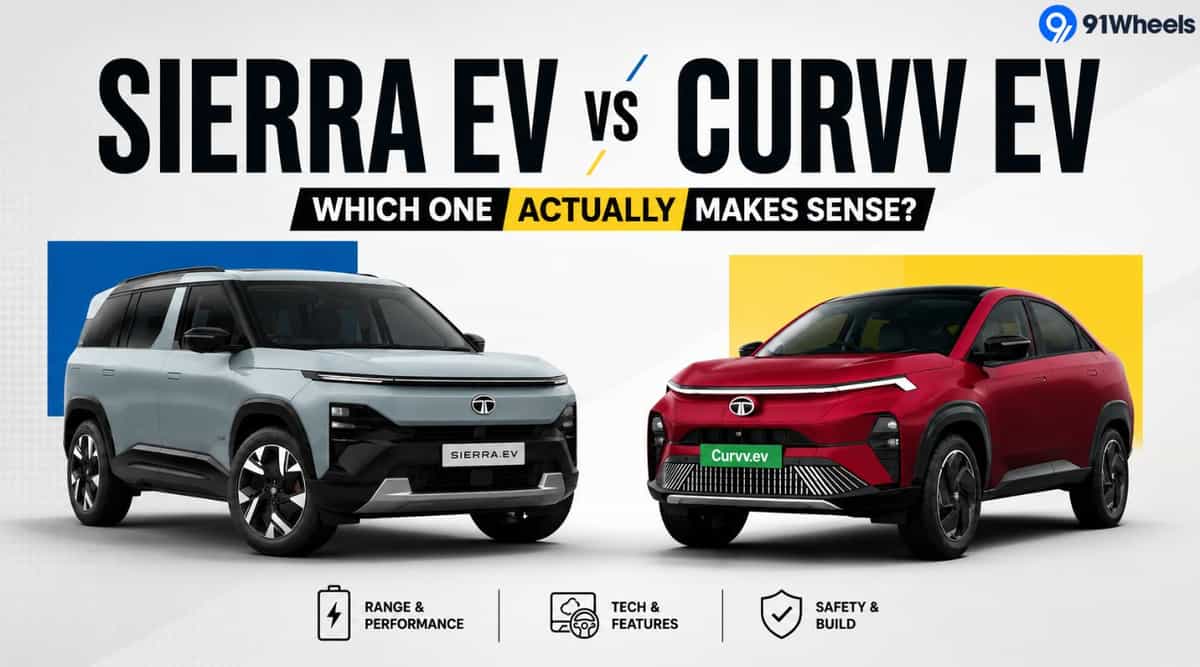
Tata has just rolled out the Sierra EV, priced from Rs. 18.79 lakh (ex-showroom), stepping into a market where it doesn't just face rivals from other brands - it faces competition from within its own lineup. The Curvv EV, launched last year at Rs. 16.99 lakh (ex-showroom), already occupies a similar price bracket.
So the question isn't "Sierra EV vs the competition," it's "why pay more for the Sierra EV when the Curvv EV is sitting right there?" Here's 91wheels take on how the two stack up against each other.
Design: Two Different Personalities
.jpg)
Design will always be a matter of taste, but the two cars are aiming at very different buyers. The Sierra EV leans into a boxy, upright SUV stance that revives the boldness of the original Sierra nameplate. The Curvv EV, on the other hand, goes for a coupe-SUV silhouette, with styling cues that echo the Nexon's front end. If you want a rugged, traditional SUV look, the Sierra wins that argument outright; if you prefer a sleeker, more urban profile, the Curvv has the edge.
Interior: Familiar, But Not Identical
.jpg)
Because both cars share components under the same brand, their cabins feel related at first glance. Look closer, though, and the gaps show up. The Curvv EV's interior comes across as a generation older than the Sierra's, with differences visible in the dashboard layout and even the AC vent design. The clearest distinction is up front: the Curvv EV uses two separate display screens, while the Sierra EV steps it up with a triple-screen "Horizon View" setup. Seat design also differs meaningfully between the two.
Features: A Long Shared List, But Notable Exclusives
-2.jpg)
Tata has been generous with features across both the cars, and the overlap is substantial - panoramic sunroofs, ventilated front seats, a JBL premium audio system, wireless Android Auto and Apple CarPlay, an air purifier, ambient lighting, a digital instrument cluster, V2L and V2V capability, OTA updates, and the Arcade.ev app suite all come standard on both.
Where the cars diverge is more telling:
Sierra EV exclusives lean into flagship SUV territory - a digital steering wheel, a Theater Pro passenger display, a 540° transparent view camera, auto park assist with remote summon, an AR head-up display (HypAR), blind-spot view monitoring, a UWB/NFC digital key, dual-motor AWD (QWD), six terrain modes, a "Boost Mode," 4-way powered co-driver seat, and a liquid-cooled 55 kWh battery pack, among others.
Curvv EV exclusives are more about everyday practicality and coupe-specific touches - a clamshell tailgate, 60:40 rear seats with recline, 500L boot space, 18-inch aero alloy wheels, front cornering fog lamps, a lifetime HV battery warranty on the 55 kWh variant, a compact urban footprint, and a class-leading claimed 0–100 kmph time of 8.6 seconds for the RWD variant.
In short: the Sierra EV throws more premium and off-road-adjacent tech at you, while the Curvv EV keeps things practical and city-friendly.
Motor and Battery: The Sierra EV Pulls Ahead on Paper
Specification | Tata Sierra EV | Tata Curvv EV |
|---|---|---|
Battery Pack | 63 kWh / 75 kWh | 55 kWh |
Motor Setup | Single Motor RWD / Dual Motor AWD | Single Motor FWD |
Power | Up to 313 PS (Dual Motor) | Up to 167 PS |
Torque | Up to 504 Nm | Up to 215 Nm |
Drivetrain | RWD / QWD (AWD) | FWD |
Claimed Range | Up to 665 km | Up to 585 km |
Real-World Range | 510–530 km (75 kWh) | ~425–450 km (55 kWh) |
0–100 km/h | 5.8 sec (Boost Mode AWD) | 8.6 sec |
Drive Modes | Eco, City, Sport, Boost | Eco, City, Sport |
Terrain Modes | Up to 6 | Not Available |
DC Fast Charging (20–80%) | ~26 min | ~40 min |
AC Charging | 7.2 kW | 7.2 kW |
Battery Warranty | Lifetime (First Owner) | Lifetime (First Owner) |
This is where the price gap starts to justify itself. The numbers make the case clearly: the Sierra EV offers a bigger battery, more power, a genuine AWD option, faster acceleration, and quicker charging. If performance and range top your priority list, the Sierra EV is the more capable machine.
Variants and Pricing: Where the Real Decision Happens
Tata Sierra EV (Ex-showroom) | Tata Curvv EV (Ex-showroom) |
|---|---|
Pure 63 – ₹18.79 lakh | Accomplished X 55 – ₹16.99 lakh |
Pure S 63 – ₹19.99 lakh | Empowered X 55 – ₹19.19 lakh |
Adventure 63 – ₹20.99 lakh | Empowered X Dark 55 – ₹19.49 lakh |
Empowered 63 – ₹22.79 lakh | — |
Adventure 75 – ₹22.19 lakh | — |
Empowered 75 – ₹23.99 lakh | — |
Empowered A 75 (RWD) – ₹24.79 lakh | — |
Empowered A 75 QWD (AWD) – ₹25.99 lakh | — |
The Curvv EV tops out at Rs. 19.49 lakh with just three variants, while the Sierra EV spans a much wider ladder, stretching all the way to Rs. 25.99 lakh for the flagship AWD version. That means the Sierra EV isn't just a pricier alternative - it's a broader range of cars aimed at a broader set of buyers, from entry-level SUV seekers to those chasing a flagship, dual-motor performance EV.
Does the Sierra EV Make Sense Over the Curvv EV?
It depends on what you're optimizing for. If your priority is a compact, city-friendly EV with a lower entry price, a sharper coupe-SUV look, and decent everyday range, the Curvv EV remains a smart, budget-conscious choice - especially at its Rs. 16.99 lakh starting price.
But if you want a traditional SUV stance, a noticeably more modern cabin, significantly more power and range, faster charging, and the option of all-wheel drive, the Sierra EV justifies its higher starting price with real, tangible upgrades rather than just badge value. For buyers willing to stretch their budget, it's the more complete package - and with variants running all the way up to a 75 kWh AWD flagship, it also gives you room to grow into a more premium EV without leaving the Tata family.
Do you like this article?
Comments
No comments yet. Be the first to comment!