Suzuki e-Access vs River Indie: Which Electric Scooter Makes More Sense?

.jpg?w=1200&q=50 "Suzuki e-Access vs River Indie: Which Electric Scooter Makes More Sense?")
Electric vehicles have started to get in demand and shape the Indian market. Suzuki has also brought its electric game to India with the e-Access, an EV version of the scooter that's been a common sight on Indian roads for years. On the other side, we have the River Indie, a scooter that has built its own identity by doing things differently from almost every other electric scooter in the market. One leans on a familiar name, the other on being genuinely unconventional. So if you're trying to pick between the two, here's how they actually stack up.
Design
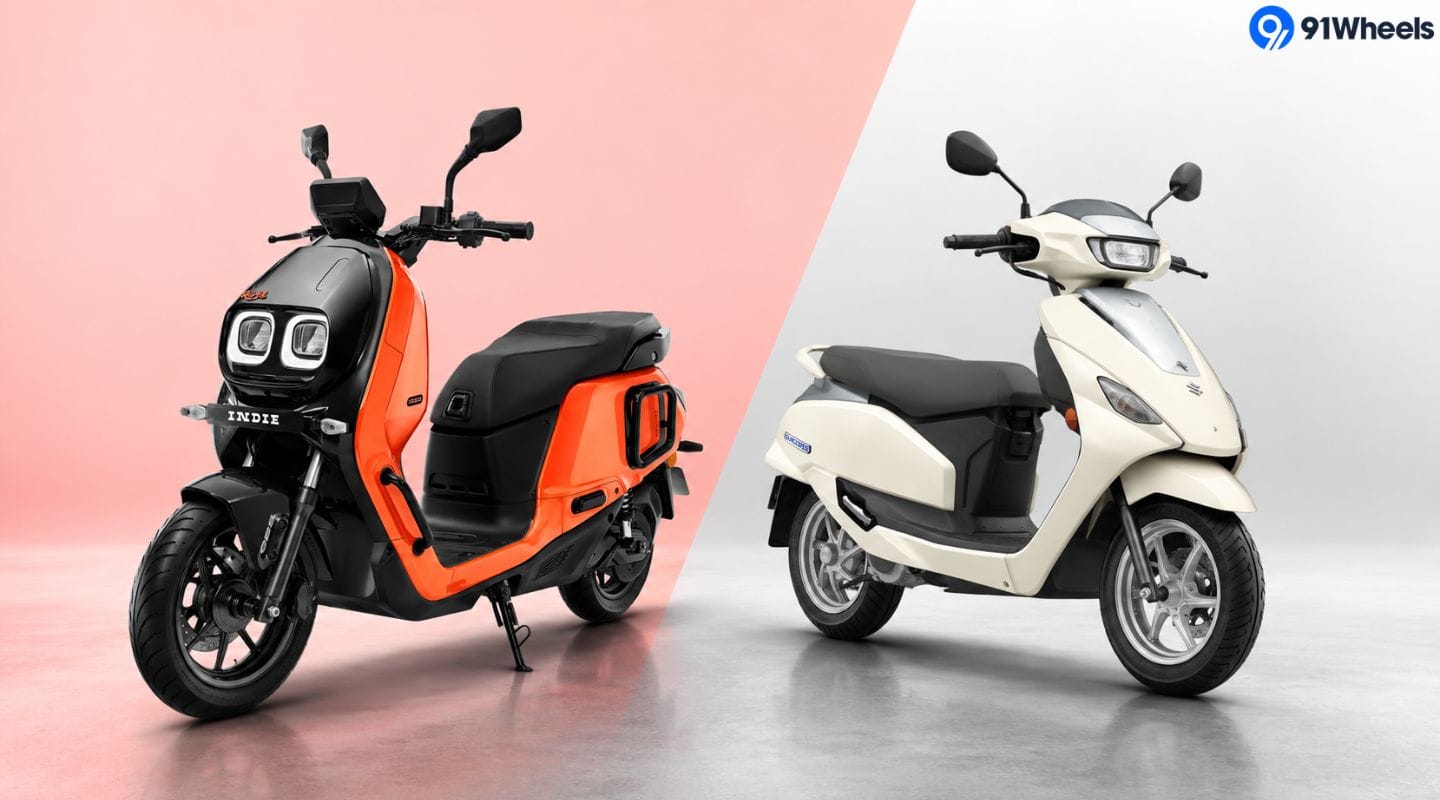
The e-Access doesn't try to reinvent anything. It carries over the same flat floorboard, and comfortable seat that Access buyers have known for years, just with an electric drivetrain slotted in. It's the safe choice if you want your EV to look and feel like the scooter you already trust.
The River Indie takes the opposite route entirely. It has a boxy, SUV like stance with a squared off front apron, twin pod LED headlamp, integrated crash guards, and even pannier stays built into the body. River calls it the "SUV of scooters," and honestly, on the road it does look like nothing else around it. If a scooter that turns heads matters to you, the Indie has the edge here by a fair margin.
Power and Performance
.png)
This is where the gap really opens up. The e-Access runs a 4.1 kW motor with 15 Nm of torque, mated to a fixed 3.07 kWh battery. Suzuki rates its top speed at 71 kmph, though some owners have reported touching close to 80 kmph in real world riding. It feels light and easy to throw around in traffic, and it even gets a reverse mode to help back out of tight parking spots.
The River Indie, on the other hand, uses a much stronger 6.7 kW motor pushing out 26 Nm of torque, paired with a 4 kWh battery. That's nearly double the power of the e-Access. Top speed is rated at 90 kmph, and there are three ride modes on offer along with reverse assist. The Indie also has a genuinely torquey character that helps it deal with inclines and flyovers without breaking a sweat, something owners frequently point out when loading up the scooter with groceries or luggage.
If outright performance is what you care about, the Indie simply has more in the tank.
Range and Charging
The e-Access claims a range of 95 km on a full charge. Charging takes about 6 hours 42 minutes with the standard charger, or roughly 2 hours 12 minutes if you use the fast charger option.
The River Indie claims a much higher IDC range of 161 km, though real world figures tend to land somewhere between 1oo and 1o5 km depending on how you ride it. Charging is the one area where it falls behind. It takes around 5 hours to top up from 0 to 80 percent, and a full charge can stretch to 8 hours, with no fast charging support currently available.
So the trade off looks familiar. The Indie goes further per charge but takes noticeably longer to refill, while the e-Access covers less distance but gets you back on the road faster thanks to its fast charger.
Features and Storage
.jpg)
The e-Access comes equipped with a spacious 7 inch TFT display that offers convenient turn-by-turn navigation guidance along with seamless smartphone connectivity features, and it also provides a generous 17 litres of practical underseat storage space for carrying your everyday essentials.
The River Indie counters with a colour LCD cluster and offers Bluetooth connectivity through its app, which connects to the vehicle via cloud and Bluetooth. Through the app, you can check the battery status while charging, view ride history, and see the last parked location. Where the Indie truly pulls ahead is storage. It offers anywhere from 43 litres of underseat space, along with an additional glove box up front. That's more than double what the e-Access offers, and it's a big deal for anyone who uses their scooter for daily errands, grocery runs, or carrying a full face helmet along with a bag.
Price
The Suzuki e-Access is priced at Rs. 1.88 lakh (ex-showroom) and comes in 4 colour options.
The River Indie is priced at around Rs. 1.52 lakh (ex-showroom), give or take depending on the city, and is currently offered in 5 colours. That makes it noticeably cheaper than the e-Access while also being the more powerful and practical scooter on paper.
Which One Should You Pick
On specs alone, the River Indie is hard to beat. It has a stronger motor, more torque, a higher top speed, a longer real world range, dramatically more storage, and a lower price tag than the e-Access. For anyone who wants a scooter that can genuinely handle longer commutes, carry more stuff, and still leave some change in your pocket, the Indie makes a strong case for itself.
The e-Access still works for a specific kind of buyer though. If you want the reassurance of a familiar name, a wide service network, and the convenience of fast charging when you're in a hurry, it remains a dependable option, even if it costs more and offers less on paper.
If you're chasing performance, storage, and value, the River Indie is the smarter buy. But if brand trust, service reach, and quick top ups matter more to you than outright numbers, the e-Access is still a scooter worth considering.
Do you like this article?
Comments
No comments yet. Be the first to comment!