


KEY HIGHLIGHTS
- Punch EV offers more range, power and features at a lower starting price
- eC3 focuses on comfort and simplicity over technology
- Safety advantage strongly favours the Punch EV (6 airbags vs 2)
Tata has just launched the Punch EV facelift at Rs 9.99 lakh (ex-showroom), and suddenly, the entry-level electric car space in India feels far more serious. This update brings a host of new features, making it one of the most loaded budget EVs in the market. It now goes head-to-head with the Citroen eC3, and in this comparison, we'll find out which one deserves your money. But before we dive into the details, make sure you join the 91Wheels WhatsApp community so you never miss any automotive updates.
Read More: Volkswagen Tayron R-Line Launched in India At Rs. 46.99 Lakh (Ex-sh): Details Here
Design

The Punch EV facelift gets a revised front bumper with a closed-off grille and a cleaner design. The earlier black trim connecting the headlamps has been removed, while the Y-shaped LED daytime running lamps (DRLs) and centrally mounted charging flap remain unchanged. It also gets new 16-inch aero-optimised alloy wheels inspired by larger Tata EVs, along with three new exterior colour options paired with a contrasting black roof. At the rear, the facelift introduces connected LED tail-lamps, bringing it in line with the ICE Punch facelift.

In contrast, the Citroen eC3 follows a completely different design philosophy. Instead of trying to look tough, it focuses on being friendly and youthful. The upright stance, tall bonnet and high ground clearance give it a crossover feel, but the styling is playful, the double-slat grille flows into the split LED DRLs, the body gets bold cladding and colour accents, and buyers can choose dual-tone combinations to personalise the car. The open grille and curved surfaces make it look more like a cheerful urban companion than a mini SUV, which perfectly matches its comfort-oriented personality.
Interiors And Features
Inside, the Punch EV facelift largely retains its familiar dashboard layout and dual-tone cabin theme, but now gets updated trim elements that make it feel more premium than before. Higher variants come equipped with a large 10.25-inch infotainment touchscreen paired with a 10.25-inch fully digital driver's display, giving the cabin a modern, almost segment-above appearance.
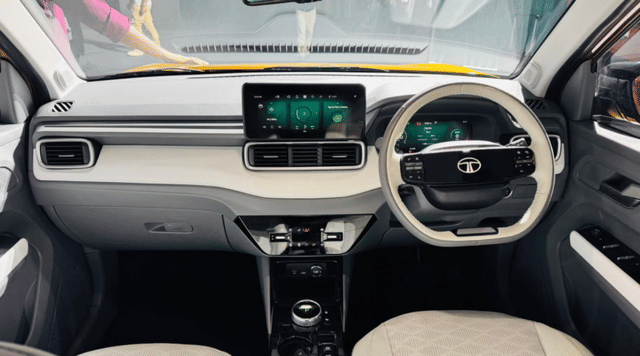
Feature highlights, depending on the variant, include wireless charging, ventilated front seats, ambient lighting, connected-car technology, and a 360-degree camera. On the safety front, Tata continues to focus heavily, offering six airbags as standard, along with high-beam assist, electronic stability control, hill-hold assist, a tyre-pressure monitoring system and ISOFIX child-seat mounts.
The Citroen eC3, meanwhile, keeps things simple and practical. Just like its petrol sibling, it is offered in two variants: Live and Feel. The higher Feel trim gets a 10.2-inch touchscreen infotainment system with wireless Apple CarPlay and Android Auto, a four-speaker audio setup and a height-adjustable driver's seat. It also features connected-car technology through the MyCitroen Connect app, offering around 35 smart functions, including checking charging status, vehicle location, driving behaviour, and nearby charging stations.
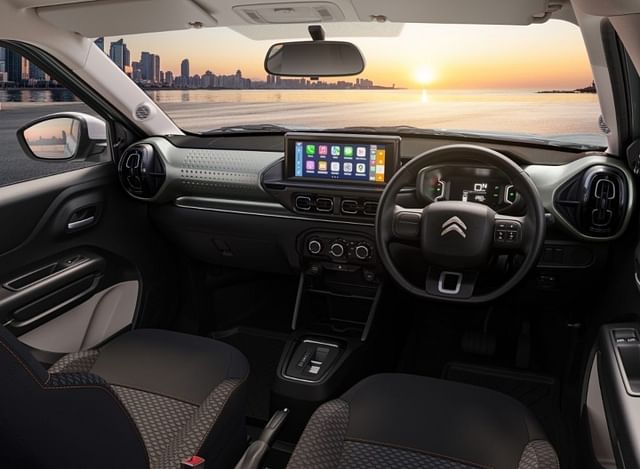
Safety equipment on the eC3 is basic compared to the Tata, with dual airbags and ABS with EBD forming the core protection package, reflecting its focus on simplicity rather than feature-richness.
| Feature | Punch EV | eC3 |
|---|---|---|
| Infotainment | 10.25-inch touchscreen | 10.2-inch touchscreen |
| Instrument cluster | 10.25-inch digital display | Analogue + MID display |
| Wireless Android Auto/CarPlay | Yes | Yes (Feel variant) |
| Wireless charging | Yes | No |
| Ventilated seats | Yes | No |
| 3600 camera | Yes | No |
| Connected car tech | Yes | Yes (MyCitroen Connect) |
| Ambient lighting | Yes | No |
| Airbags | 6 airbags | 2 airbags |
| Other safety | ESC, hill hold, TPMS, ISOFIX | ABS with EBD |
Powertrain And Battery
| Specification | Punch EV | eC3 |
|---|---|---|
| Battery options | 30kWh / 40kWh | 29.2kWh |
| Power | 88hp / 129hp | 57hp |
| Torque | 154Nm | 143Nm |
| Claimed range | 365km / 468km | 320km |
| Real-world range | 355km (40kWh) | 250-280km approx |
| Fast charging (10-80%) | 1 hour approx | 57 minutes |
| Home charging | 6-10 hrs (variant dependent) | 10.5 hrs |
| Warranty | Lifetime battery warranty | Standard warranty |
The Punch EV facelift comes with two battery options: 30kWh and 40kWh, paired with a front-mounted motor driving the front wheels. The larger battery delivers an ARAI-claimed range of 468km (around 355km real-world), while the smaller pack is rated at 365km. Power output stands at 129hp for the 40kWh version and 88hp for the 30kWh variant, both producing 154Nm of torque. Tata also offers a lifetime, unlimited-kilometre battery warranty.
The Citroen eC3 uses a 29.2kWh battery with a front-axle-mounted motor producing 57hp and 143Nm. It has an ARAI-claimed range of 320km. Charging includes DC fast charging from 10-80 per cent in about 57 minutes and a 3.3kW AC home charger that takes roughly 10.5 hours for a full charge.
Pricing
The updated Punch EV now undercuts its earlier pricing strategy, with a starting price of Rs 9.69 lakh and a top end of Rs 12.59 lakh (ex-showroom), significantly reducing the gap between variants and making the larger-battery versions far more attainable than before.
The Citroen eC3 sits slightly higher in the bracket, beginning at Rs 11.50 lakh and extending to Rs 12.43 lakh for the fully equipped dual-tone Feel variant.
| Punch EV | eC3 | |
|---|---|---|
| Starting price | Rs 9.69 lakh | Rs 11.50 lakh |
| Top price | Rs 12.59 lakh | Rs 12.43 lakh |
Read More: Tata Punch EV Facelift Launched At Rs 6.49 Lakhs BaaS Price: 468 Km Range
Verdict
The comparison ultimately comes down to priorities: the Punch EV is the more complete and future-ready package, offering stronger performance, longer range, far more features and a significantly better safety kit while also starting at a lower price, making it the logical choice for most buyers, whereas the Citroen eC3 takes a different approach by focusing on simplicity and comfort, delivering an easygoing urban driving experience that will appeal to those who prefer relaxed daily usability over technology and specifications.
Do you like this article?
Comments
No comments yet. Be the first to comment!