.png?w=1200&q=50 "Yamaha Aerox-E vs TVS X: Which One Deserves a Spot in Your Garage?")
The crossover scooter segment in India has changed shape in the last year. It's no longer just about looking sporty, riders now want real performance to back that look, and two scooters are leading that charge. Yamaha’s Aerox-E, launched recently at Rs 2.81 lakh (ex-showroom) and the TVS X which comes at a price of Rs 2.66 lakh (ex-showroom) are competing against each other on almost every front, design, performance or tech. And now both have crossed the Rs 2.50 lakh mark, which is a big deal in this segment. That said, one question naturally arises: are these scooters actually worth that kind of money, and more importantly, which one gives you more for what you pay? Let’s find out in this article.
Aerox-E Vs TVS X: Design
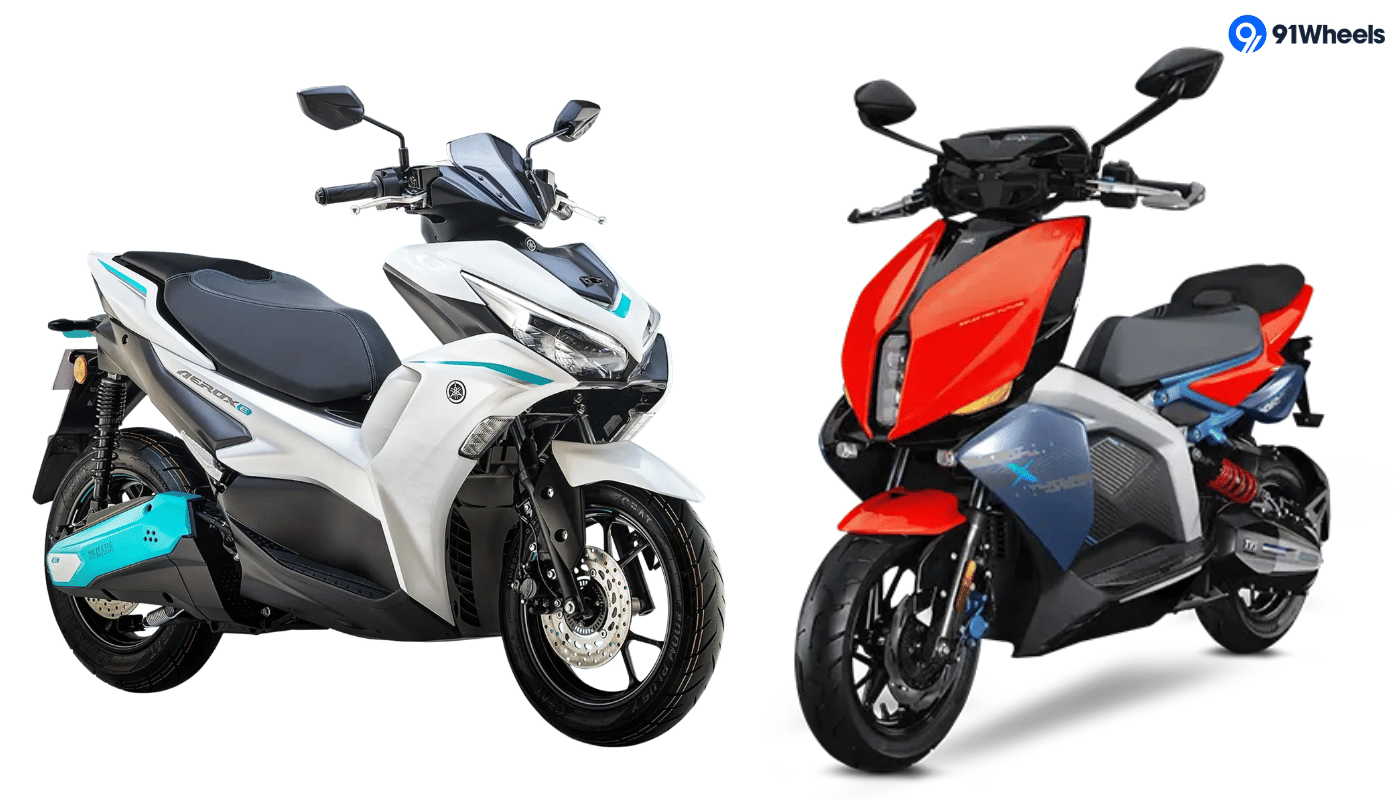
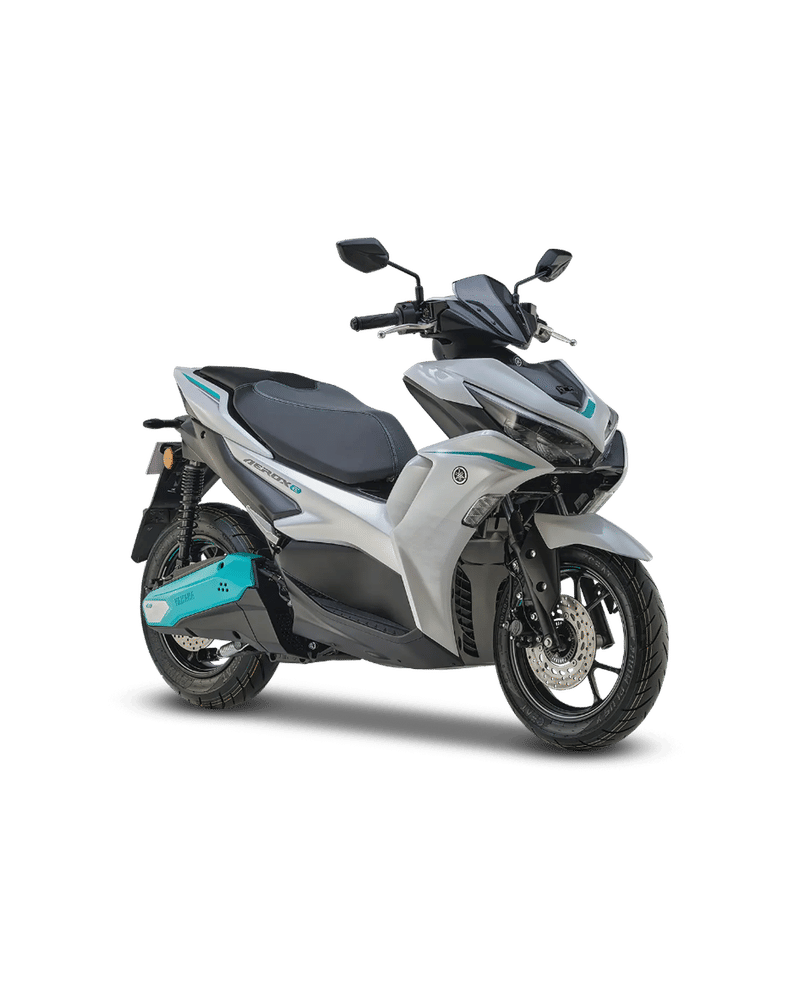
The Aerox-E has adopted the similar design of its ICE sibling, the Aerox 155. It has borrowed the same muscular stance, sharp LED lighting, and the sporty silhouette. It is only when you notice the electric motor tucked into the swingarm that you realise this is not the petrol version. It is evident that Yamaha has chosen a safer approach with the Aerox-E, relying on the strong Aerox brand name and its loyal fanbase instead of taking a bold step with a fresh, electric performance scooter.
On the other hand, TVS has taken a different path, introducing a new nameplate and design, there is no ICE scooter this design borrows from. The TVS X design language looks futuristic, aggressive, and performance oriented. With a trellis subframe, single-sided swingarm, and a motorcycle-like rear end, the X looks unlike anything else on Indian roads. However, when it comes to design, it ultimately remains a matter of taste. If you prefer a familiar face, the Aerox-E is the safer bet. If you want something that stands out and turns heads, the TVS X is the one to experiment with.
Battery, Motor and Performance
.png)
This is where things matter the most, as these crossover scooters are built around outright power and torque. The Aerox-E generates a peak power of 9.4 kW and a torque of 48 Nm, and with this setup the scooter achieves a top speed of 95.5 km/h. It comes with a dual removable battery pack setup, each rated at 1.5 kWh, which can also function on a single battery if needed. The scooter takes 3 hours and 10 minutes to charge from 0-100 percent (single pack). Once both batteries are charged, it offers an IDC range of 117 km.
.png)
These numbers look good on paper, but if you are an enthusiast who thrives on outright speed, real-world performance is unlikely to impress you. For a crossover that is meant to deliver on speed and performance, these figures fall short. Range (117 km), too, is just good for the segment, but sustained riding above 80 km/h will bring it down drastically to somewhere between 80-85 km.
The TVS X, on the other hand, generates a peak power of 11.7 kW and a torque of 40 Nm. This lets the scooter sprint from 0-40 kmph in just 2.5 seconds, with a top speed of 110 kmph. The motor is backed by a 4.4 kWh battery pack, which charges from 0-80 percent in 3 hours and 30 minutes using a 950W portable charger.
.png)
On the performance front, the TVS X takes a clear lead with more power, more torque, and a bigger battery pack. It offers a higher top speed of 110 kmph, a quicker charging option, and does all this at a lower price than the Yamaha Aerox-E. However, range anxiety hasn't completely disappeared. As with most electric vehicles, sustained high-speed riding significantly reduces the achievable range.
Specification | Yamaha Aerox-E | TVS X |
|---|---|---|
Peak Power | 9.4 kW | 11.7 kW |
Peak Torque | 48 Nm | 40Nm |
Battery Pack | Dual removable batteries (1.5 kWh × 2) – 3.0 kWh total | 4.4 kWh fixed battery pack |
Charging Time | 3 hours 10 minutes (0-100%, single battery) | 3 hours 30 minutes (0-80%) |
IDC Range | 117 km | 140 km |
Top Speed | 95.5 kmph | 110 kmph |
0-40 kmph Acceleration | N/A | 2.5 seconds |
Aerox-E Vs TVS X: Feature
Both scooters come loaded with a solid set of features. Here's how they stack up against each other.
.png)
Feature | Yamaha Aerox-E | TVS X |
|---|---|---|
Console Type & Size | 5-inch TFT colour display | 10.2-inch TFT touchscreen display |
Riding Modes | Eco, Standard, Power | Xtealth, Xtride, Xonic |
Lighting | Full LED lighting setup | Full LED lighting setup with cornering lights |
ABS | Single-channel ABS | Single-channel ABS |
Hill Hold Assist | No | Yes |
Traction Control | Yes | No |
Reverse Mode | Yes | Yes |
Connectivity Features | Bluetooth connectivity, navigation, smartphone integration | Navigation, voice assist, smartwatch connectivity, smartphone integration |
Keyless Features | Smart key with answer-back function | Digital key and keyless operation |
The TVS X clearly wins on features, its 10.2-inch screen, hill hold assist, and extra connectivity options make it feel more premium. The Aerox-E fights back with traction control and removable batteries, a genuine convenience for riders without home charging. On paper, TVS X feels more loaded, but the Aerox-E's battery flexibility is hard to ignore in real-world use. Moreover, the TVS X's larger console isn't something every rider will love. At 10.2 inches, it's genuinely bigger than the infotainment screens on some SUVs.
Dimension and Storage
.png)
Being crossovers built for sporty performance, neither of these scooters was designed with cargo space as the priority. You can't carry much on either, though a helmet can still be expected to fit, depending on its size. But most owners will still end up using these as their daily ride, and for that, dimensions and storage matter just as much as outright performance. Here's how the Aerox-E and TVS X compare on this front.
Dimension and Storage Table:
Parameter | Yamaha Aerox-E | TVS X |
|---|---|---|
Length | 1980 mm | Not officially disclosed |
Width | 700 mm | Not officially disclosed |
Height | 1150 mm | Not officially disclosed |
Wheelbase | 1360 mm | 1285 mm |
Seat Height | 812 mm | 770 mm |
Kerb Weight | 139 kg | 137 kg |
Under-seat Storage | 15 litres | 19 litres |
TVS hasn't officially disclosed the length, width, and height of the X, so an exact comparison isn't possible. Going by wheelbase alone, the Aerox-E's 1360mm is 75mm longer than the TVS X's 1285mm, hinting that the Aerox-E is the bigger scooter overall.
Even looking at the two side by side, the Aerox-E appears to be the bigger and wider scooter, carrying that bulky maxi-style stance. Moreover, its 812mm seat height is noticeably taller than the TVS X's 770mm, making it harder to flat-foot for shorter persons, and its storage is smaller too at 15 litres against the TVS X's 19 litres. So, while the Aerox-E has the bulkier, more dominating road presence, the TVS X is the easier and more practical scooter to actually live with in your daily life.
Conclusion
Having gone through both scooters closely, this feels like one of the closer contests in the crossover space. Neither wins on every front. The Aerox-E rides on Yamaha's brand pull, familiar design, traction control, and removable batteries, but gives up ground on performance and storage. The TVS X, in 91Wheels opinion, feels like the more complete package, more power, longer range, a sharper display, and useful extras, all at a lower price. TVS is yet to reveal the X's exact dimensions, and we'll be measuring those ourselves in a future 91Wheels test. Until then, going by the available wheelbase figures, the Aerox-E appears to be the larger scooter. However, buyers today want more than just badge value, and that's where the TVS X makes a stronger case
Do you like this article?
Comments
No comments yet. Be the first to comment!