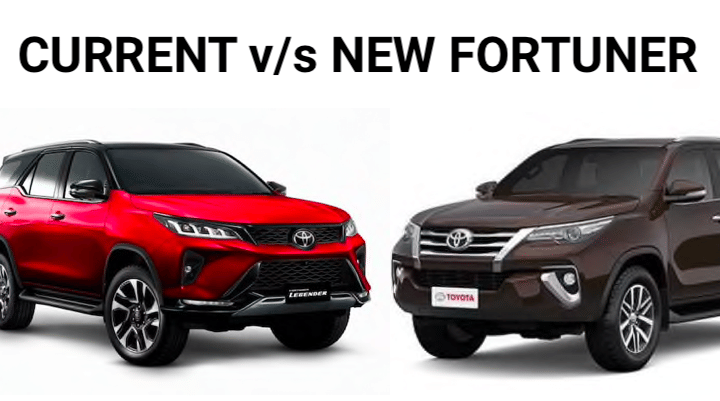
Toyota Fortuner is a decade-old SUV in the Indian market and in 2016, it received its second-generation avatar. Jump forward to 2020, we have seen several spy shots of the facelift of the second-gen model and the cosmetic changes it gets. Unlike India, the international markets do get mechanical changes too. In this article, we compare the 2020 Toyota Fortuner vs Old Fortuner in terms of design, engine and features!
Exterior Design 2020 Toyota Fortuner vs Old Fortuner

The overall silhouette of the facelifted SUV remains identical to the previous-gen, however, the noticeable changes are visible to the naked eyes. That includes an updated grille design which is larger than before and finished in black. The front bumper is new and so are the fog light housing, LED DRLs (Daytime Running Lights) and revised LED headlights. Moving towards the side profile then it retains the tall posture but now comes in new alloy wheels design. The rear profile accounts for the new LED taillights with improved bumper design.
Updated Cabin Design

If you were expecting vast changes on the inside then you will be highly disappointed. We say it because it looks more or less the same as the pre-lift model. The only change on the upholstery part is that it is now of the darker shade. Moving onto the centre console then the 7.0-inch touchscreen is now replaced by a larger 8.0-inch unit and the Legender variant gets a 9.0-inch head. It is not sure whether Toyota will launch the Legender trim in Indian markets or not. Upon closer look at the instrument cluster, it also received mild changes. Well, that's it! The interiors are done!
Also Read: Will The Ford Endeavour Petrol Come To India? Possible Toyota Fortuner Petrol Rival!
More Power On Tap

Toyota Fortuner retains the 2.7-litre petrol and the 2.8-litre turbo diesel engines. It is the latter which receives a power bump of 27 PS and 50 Nm from before. The new figures now touch 204 PS and 500 Nm of peak torque and Toyota also claims that the new engine is now more efficient and cleaner. Sadly, we are not sure whether the power bump will be seen on the Indian versions or not.
The diesel mill receives a 6-speed manual and a 6-speed auto gearbox. Sharing details on the 2.7-litre petrol engine then it makes 165 bhp with 245 Nm of peak torque. The engine gets mated to a 5-speed manual and a 6-speed auto unit. The Thailand markets receive the 2.4L diesel mill which is also used in the Innova Crysta here.
Features

The Legendary variant of the Fortuner gets modern connectivity features like Apple CarPlay, Bluetooth Connectivity but missed out on the Android Auto. To further improve the sound quality, it gets an in-built JBL sound system with 9 speakers with a sub-woofer. It also gets Automatic IRVM, 360-degree camera, wireless charging, ambient lighting on the door pad and Activated Kick Door. The latter works when you wave your leg underneath the SUV to open the boot. Let's see if these features come to the Indian shores or not!
Also Read: Top Five Kia Seltos Aftermarket Alloy Wheels Design - Images
Prices
With every facelift, the prices of the cars/SUVs are increased and it is safe to say that Toyota will play with its pricing. The only thing we are expecting is whether the prices will be justified for the features the updated model has to offer or it will continue to rely on the sales because of brand image and the reliable engine? Currently, Toyota Fortuner starts from Rs 28.68 lakh and goes up to Rs 34.68 lakh, ex-showroom, Delhi. Once launched, it will compete with the likes of Ford Endeavour, Mahindra Alturas G4 and Isuzu MU-X.
Do you like this article?
Comments
No comments yet. Be the first to comment!