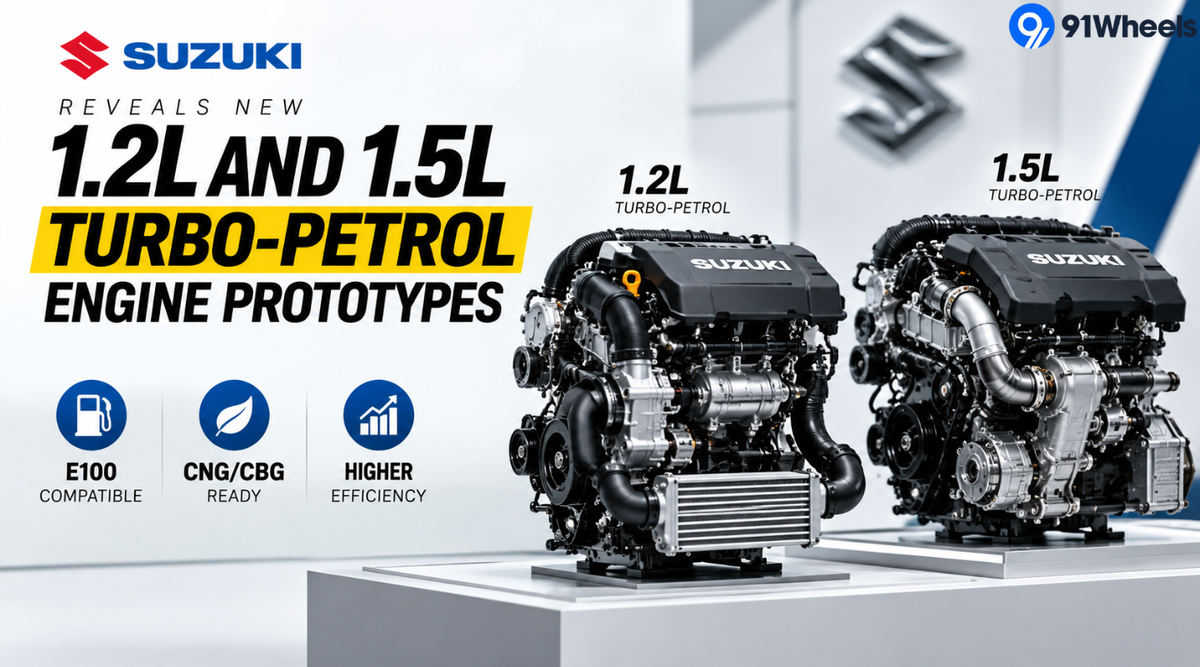
At its "Technology Strategy 2026: Looking 10 Years Ahead" roadmap, Suzuki revealed the prototype for a 1.2 litre direct injection turbocharged engine based on the Z12E 3-cylinder architecture. This engine is engineered to be compatible with CNG, 100% ethanol, and CBG, short for compressed biomethane gas. Other powertrains showcased at this event were a hybrid one based on the same 1.2 litre and a 1.5 litre turbocharged engine. At last, these new hearts are most likely to be offered in India in coming years. More information about it is below.
1.2 Litre Turbo Engine
First, let's talk about the 1.2-litre DITC engine, which is being developed to produce up to 126hp and 230Nm while targeting thermal efficiency of over 40% at launch and up to 50% by 2035. A thermal efficiency of 40% means that roughly 40% of the fuel's energy is converted into useful mechanical work, with the rest lost through heat, exhaust and friction.
For comparison, many conventional petrol engines operate in the 25-30% range under typical conditions. If Suzuki can achieve 40% thermal efficiency in a production engine, it would represent a significant improvement in efficiency. The engine uses technologies such as a variable-geometry turbocharger and a water-cooled intercooler to improve performance and efficiency.
It is also being developed to run on E100, CNG and CBG. According to Japan’s MotorFan, the engine is based on Suzuki’s Z12E three-cylinder unit, currently available in naturally aspirated form in the Swift, Baleno and Dzire. While Suzuki has not confirmed its production plans for India, this turbocharged version could be used in sub-4 meter cars in the future.
Hybrid Setup
Additionally, the same Z-series architecture is being used as the base for a new hybrid setup featuring a 0.6 kWh battery pack and two electric motors. In this setup, the engine does not directly drive the wheels but acts as a generator, producing electricity that powers the electric motors. The engine itself produces 82hp and 108Nm, while the generator motor produces 83hp and the traction motor, which drives the wheels, produces 88hp.
This combination can produce up to 177hp, which could result in strong performance while also offering good fuel efficiency. However, only limited information is available about this hybrid setup at the moment.
1.5 Litre Turbo Engine
Moving on to the larger 1.5-litre turbo engine, it is being developed to produce 160hp and 280Nm, while also being compatible with E100, CNG and CBG, according to Autocar Japan. The engine is based on Suzuki’s K15B unit, which is currently used in the Maruti Suzuki Brezza, Grand Vitara, Ertiga, Victoris and Jimny in India. If introduced in India, this engine is likely to be used in cars above 4 metres in length, primarily mid-size SUVs.
Suzuki also showcased a 0.66-litre three-cylinder engine for Kei cars. It will be offered in both naturally aspirated and turbocharged forms, although more details about this engine are yet to be revealed.
Lastly, these engines are being developed primarily for front-wheel-drive cars with a transverse engine layout. Suzuki has not mentioned any rear-wheel-drive applications so far, which means models such as the Jimny may not be part of this engine strategy.
End Note
91Wheels believes the 1.2-litre DITC engine could be a good fit for several current and future Maruti Suzuki models, as it would address two key requirements at once: achieving thermal efficiency of up to 40% while also being compatible with E100 fuel. With the Indian automotive industry gradually moving towards higher ethanol-blend fuels, this could make the engine particularly relevant for Maruti Suzuki’s future lineup. Now, all eyes are on Maruti Suzuki to announce which car will get this engine first.
Do you like this article?
Comments
No comments yet. Be the first to comment!